Categorías
nuevo blog
Why DFM Matters Before Design Freeze in Custom Product Development
In our more than 20 years of providing custom manufacturing services, we have seen many brands reach a point where, after a lengthy design and development process, they believe the product is ready for design freeze because the drawings are complete and a prototype has been built. They assume the next steps are simply to arrange factory sampling and production before preparing for launch. However, when the product reaches the manufacturer's engineering review stage and the team begins refining the structure, developing molds, and planning production, the factory's technical team may raise different concerns: "The product can be made, but the current design carries significant manufacturing risks." "The mold needs a greater draft angle, so the structure must be adjusted." "The tolerances are too tight for the existing process to achieve consistently." After round after round of manufacturing-related revisions, the launch timeline gets longer. The final product may also differ significantly from the originally frozen design, leaving the brand's product development team frustrated.
These problems do not necessarily mean the design team lacks the necessary skills. Often, they arise from a gap between design work and manufacturing evaluation. Product design typically focuses on function, appearance, user experience, and product positioning. Manufacturing teams must also consider material processing, part forming, assembly conditions, inspection methods, and consistency in mass production. When these factors are not adequately discussed during the design stage, some problems remain hidden until mold development or trial production. By then, making changes often involves more parts, suppliers, and development resources.
For custom products, the value of DFM (Design for Manufacturability) is that it allows design decisions to be evaluated against manufacturing requirements early in the process. Design freeze should not simply mean that the drawings are complete. It should be based on a clear understanding of the major manufacturing risks. The team should determine which design elements can move forward, which issues need to be addressed, and which conditions still require prototype or trial production validation. This makes DFM before design freeze a key step in the product development process.
Why a Completed Design Is Not Always Ready for Manufacturing
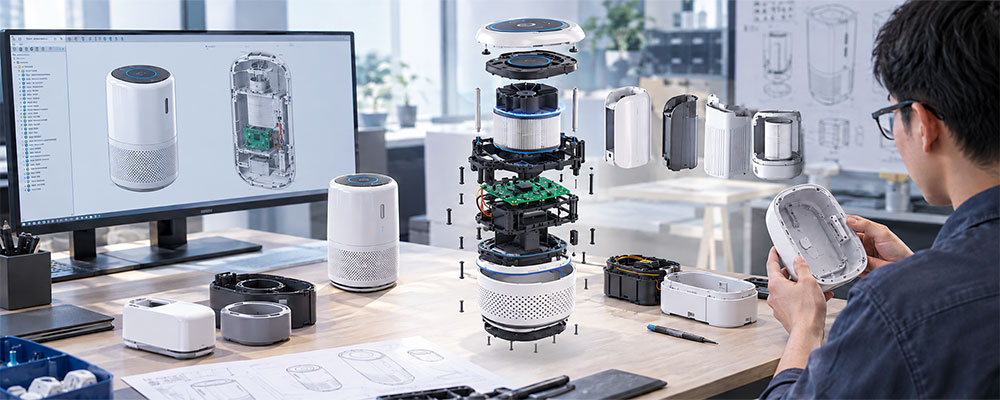
A completed design usually means that the functional prototype has passed testing, the appearance has been approved, and key dimensions have been defined in the drawings. Manufacturing readiness involves a different set of considerations. The process window, mold design, assembly sequence, inspection methods, and variation in incoming materials all need to be considered together. Meeting functional requirements does not mean the structure is suitable for the intended manufacturing process. An attractive appearance does not guarantee that a housing can be released from the mold consistently. Correct dimensions on a drawing do not guarantee that the specified tolerances can be achieved reliably.
Take a household fruit and vegetable washer as an example. The brand wants a compact product, a close fit between the water tank and cleaning basket, clear button feedback, and an attractive transparent window. These features can be achieved at the prototype stage using rapid prototypes and a small number of machined parts. But once mold development begins, problems may emerge. The transparent window's snap-fit features may be too thin, causing whitening after injection molding. The gap between the cleaning basket's guide rails and the housing may be too small, causing the basket to stick during assembly. A right-angle groove for the sealing ring may make assembly difficult for workers and lead to inconsistent leak-test results. These are not problems with the product's operating principle. They arise because manufacturing and assembly requirements were not considered early enough in the design.
Being able to manufacture individual parts does not mean the complete product can be assembled and inspected smoothly. A part that passes inspection at a supplier's facility may not fit on the final assembly line because the locating references are different. A sealing structure that passes a water test in the lab may leak during mass production because of variations in incoming part dimensions. A control board that passes functional testing may cause the entire product to reset during aging tests because wires are pinched or compressed. DFM evaluation brings these connection points into the discussion early.
Design freeze provides a stable basis for purchasing, mold development, fixture preparation, and trial production. If manufacturing issues remain unresolved before design freeze, every subsequent structural change may affect molds, certification, packaging, instruction manuals, and inventory. The brand sees launch delays, the factory faces rework and scrap risks, the buyer faces cost uncertainty, and the supply chain manager sees plans repeatedly disrupted. DFM in custom product development is not about starting the design over. It is about turning manufacturing conditions into design inputs while keeping the product goals unchanged. The design team is responsible for defining the product, while the manufacturing team evaluates process feasibility, assembly efficiency, and quality consistency. Design freeze becomes meaningful when both sides make informed decisions based on the same drawings.
What Should Be Reviewed Before Design Freeze?
A DFM review before design freeze should focus on issues that affect subsequent manufacturing decisions, rather than requiring every technical detail to be finalized at this stage. The depth of the review depends on product complexity, design maturity, the intended manufacturing process, and project risks. For requirements that are already clear, the team should confirm that the design meets them. For issues that lack sufficient evidence, the team should document what still needs to be validated.
Manufacturing process is one of the basic conditions to confirm. The team should identify the planned process for major parts, such as injection molding, sheet metal fabrication, machining, or other suitable methods, and determine whether the current design meets the basic requirements of that process. Different processes have different capabilities and limitations when it comes to structure, dimensions, materials, and production volume. If the intended process has not yet been selected, some structural decisions may lack a reliable manufacturing basis. The team should compare feasible options and their limitations rather than assuming too early that one process is necessarily the best choice.
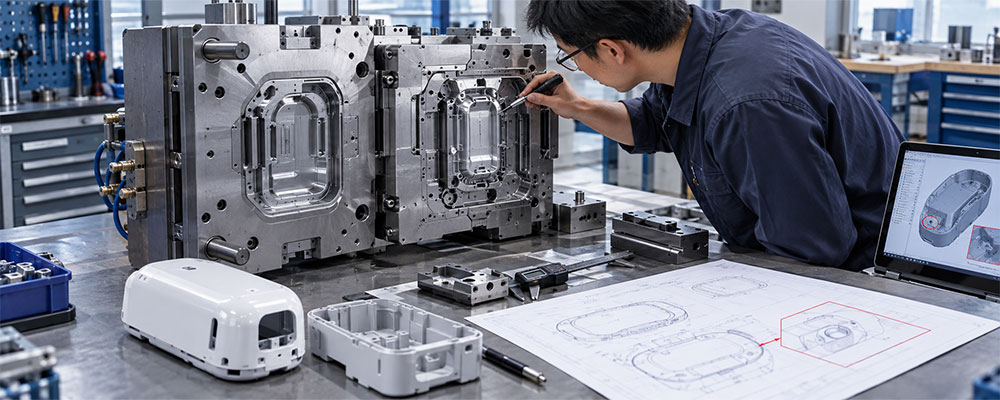
Structural feasibility should be reviewed with a focus on areas that affect part forming, assembly, and product function. For plastic parts, the team should consider wall thickness, reinforcement features, mold release, and potential deformation. Products containing water paths, motors, pumps, or electronic components also require checks of internal space, part interfaces, fastening methods, and maintenance access. The review does not mean every detail must be changed immediately. Its purpose is to determine whether the current structure has clear manufacturing obstacles and whether adjustments are needed before design freeze.
Materials and tolerances should be evaluated against actual performance requirements. Material selection needs to account for the operating environment, mechanical strength, water resistance, resistance to chemicals, processing methods, and supply availability. Tolerances should match the function of each part and how it fits with other components. Dimensions that affect sealing, positioning, or moving parts usually require more clearly defined controls than noncritical appearance dimensions. The design and manufacturing teams should agree on which dimensions require tighter control and which can be set based on actual process capabilities, rather than applying the same precision requirements to every feature.
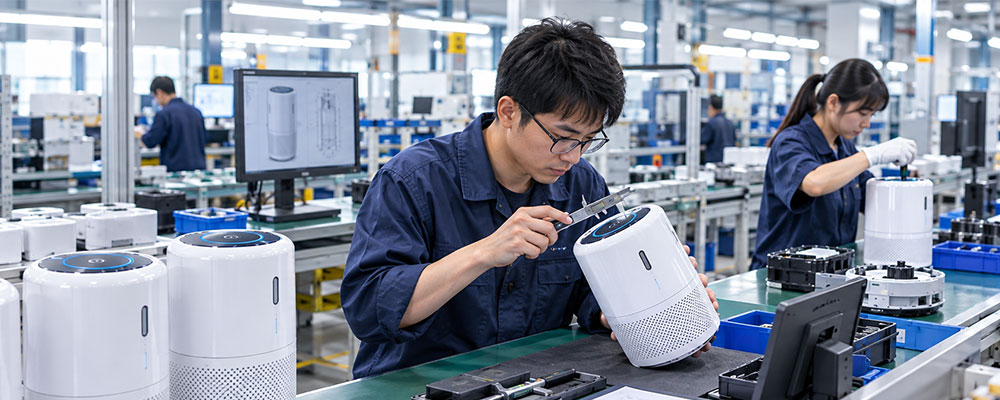
Assembly and quality control should be evaluated to determine whether the product can be assembled consistently using defined work steps and whether key quality requirements can be inspected. The team should check whether there is enough space for fastening operations, whether connectors and wire harnesses are easy to install, whether sealing components can be positioned correctly, and whether key parts need features to prevent incorrect assembly. For characteristics that affect safety, function, or reliability, suitable inspection methods and acceptance criteria should also be considered early. If the design does not support consistent assembly and effective quality checks, the finished product may still have consistency issues even when individual parts meet their drawing requirements.
Open risks should also be documented. Which issues have been resolved? Which require prototype testing? Which need molded samples? Which require a small trial production run? Which require material certificates or process capability information from suppliers? The risk log does not need to be complicated. Every unresolved issue should have an owner, a validation method, a target date, and acceptance criteria. Design freeze does not mean eliminating every risk. It means understanding the major risks and planning the necessary follow-up validation.
When Should a Manufacturer Get Involved?
The timing of involving a manufacturing provider should match the maturity of the design. During the concept and requirements definition stages, the brand can start discussions with product goals, usage scenarios, preliminary appearance concepts, and a list of desired functions. The manufacturer can assess whether the proposed manufacturing approach is reasonable and identify key constraints. For example, a household produce washer may need to be compact, easy to disassemble and clean, quiet, and equipped with a transparent viewing window. The manufacturer can point out where these goals may conflict. A smaller product leaves less room for water paths and electronics. A design that can be disassembled for cleaning affects sealing and snap-fit features. A transparent window affects material selection and appearance standards. Low noise affects pump selection and vibration-damping design.
During preliminary structural design, the manufacturer can review major parts and their assembly relationships. Are the housing sections laid out appropriately? Are the internal supports adequate? Is the control board positioned safely? Are the interfaces for the water pump, air pump, valves, filter, and cleaning basket clearly defined? Are the selected materials suitable for the operating environment? Feedback at this stage can prevent major design mistakes. The design team does not need to finish every detail before asking for input. Once the key structural elements begin to take shape, the manufacturer can provide a list of potential risks.
During detailed design, the manufacturer can evaluate critical dimensions, part interfaces, and manufacturing processes. For injection-molded parts, the review should cover mold release, gate locations, deformation, and weld lines. For metal parts, it should cover bending, stamping, welding, and surface treatment. For electronic components, it should cover board layout, connectors, wiring, heat dissipation, and water protection. For assembly, it should cover work sequence, error prevention, fixtures, and testing. Changes are relatively inexpensive at this stage. The drawings have not all been frozen, the molds have not yet been built, and suppliers have not purchased large quantities of materials. Manufacturer feedback can be incorporated into the design more quickly, and the team can make better component selections.
Before design freeze, the manufacturer should confirm the status of major issues. Which structural changes have been completed? Which tolerances have been adjusted? Which materials have been confirmed? Which tests have passed? Which issues still require molded samples or trial production? Unresolved risks need a follow-up plan. Brands do not need to treat the manufacturer as a final approval gate. The manufacturer should be an early development partner. The earlier it gets involved, the more effectively its manufacturing experience can help mature the design.
Consider a salad washer and purifier. The custom product has a compact structure and contains a purification module, motor, control board, removable cleaning basket, and sealing components. The brand wants a compact size, a simple appearance, intuitive operation, and a basket that is easy to remove. During the preliminary structural design stage, the manufacturer can point out that placing the purification module's connector at the bottom would route wires through the drive area. If the removable basket relies only on the outer housing for positioning, alignment may vary during mass production. If the control board is positioned close to the motor, vibration and electrical interference need to be evaluated early. The manufacturer can also recommend suitable connectors, wire harness lengths, sealing ring specifications, and assembly sequences. These suggestions do not change the product definition, but they can help the design mature more quickly. In collaboration between product design and manufacturing, the earlier the manufacturer gets involved, the more likely it is that changes can be made while the structure is still easy to adjust.
How to Integrate DFM into Custom Product Development and Production
Integrating DFM into the product development process depends on having clear review stages, the right participants, documented issues, defined decision-making responsibilities, and planned validation. Reviews can be tied to design milestones: concept review, preliminary structural review, detailed design review, and design freeze review. Each stage focuses on different issues. The concept stage covers manufacturing processes and key constraints. The preliminary structural stage covers structural design, materials, and assembly risks. The detailed design stage covers critical dimensions, interfaces, fixtures, and inspection. Before design freeze, the team reviews the status of major issues and plans for unresolved risks.
The participants should represent the key functions involved. Depending on the project, they may include the product owner, design engineers, manufacturing engineers, purchasing, quality, and supplier representatives. The product owner confirms product requirements and trade-offs. Design engineers are responsible for drawings and structural design. Manufacturing engineers assess processes and assembly. Purchasing confirms supply availability and cost. Quality confirms inspection methods and standards. Suppliers confirm mold and fixture requirements and their ability to meet incoming material specifications. Not everyone needs to attend every meeting, but the people responsible for key decisions should be involved at the relevant stages. Issues should be recorded in a shared system rather than left in chat histories.
Design issue records should be simple and practical. Each entry should clearly describe the issue, its impact, the proposed action, the person responsible, its status, and the validation method. Statuses can be classified as open, in progress, closed, or pending validation. For issues awaiting validation, specify the method, such as prototype testing, molded samples, small-batch trial production, or reliability testing. Closed issues should have supporting evidence. The purpose of issue tracking is not to assign blame. It is to ensure that design, engineering, purchasing, and manufacturing teams are working from the same information.
Decision-making responsibilities must also be clear. The brand decides whether product requirements should change. The design team is responsible for structural solutions. The manufacturer assesses process feasibility. Purchasing and the brand evaluate cost changes together. Quality requirements and acceptance criteria are confirmed by the quality team and the brand. Without a designated decision-maker, issues may be discussed repeatedly without resolution. Without a validation plan, they may remain unresolved until trial production. The design freeze review should produce a clear decision: which elements can be frozen, which can be frozen subject to conditions, and which cannot yet be frozen. Any conditional approval should include the conditions and completion dates.
Information must be shared promptly. Design changes should be communicated to manufacturing, purchasing, and quality. Supplier changes should be communicated to design and quality. Test results should feed back into the design process. Trial production issues should be included in the next review. DFM before design freeze cannot be achieved through a single report. It depends on ongoing communication and milestone reviews. Brands need a clear process for bringing manufacturing feedback into design decisions and communicating design decisions back to manufacturing. This allows the product development process to move forward in sync and turns design for manufacturability into a practical development habit rather than just a slogan.
What Should Be Confirmed Before Moving to the Next Stage?
Before design freeze, a short stage-gate checklist can help confirm whether the current design is ready to move to the next stage. The purpose is not to prove that the product is free of all risks. It is to confirm that the team has identified the main manufacturing issues and made clear plans for anything that remains unresolved.
When each of these questions has a clear outcome or follow-up plan, the team can use the available evidence to decide whether the design is ready to be frozen. Projects with low risks and sufficient supporting evidence can move forward. Issues that may affect core functions, critical structures, or mass-production feasibility should be evaluated further before design freeze, or be subject to clearly defined limitations and validation requirements. The purpose of DFM is not to resolve every manufacturing issue once and for all during the design stage. It is to ensure that manufacturing requirements are fully considered before key design decisions are made. For brands using an ODM/OEM manufacturing service, design freeze should mean that the main design direction has undergone the necessary manufacturing review and that there is a clear plan for any remaining risks. Manufacturing feasibility is not just about whether a factory can make the product. It also means whether the supply chain can provide components consistently, quality can be controlled reliably, and costs can stay within the target range. The better the timing of manufacturer involvement matches the development stage, the more opportunities both sides have to resolve issues while the structure can still be adjusted and the design documents are not yet finalized, reducing the impact of later changes on molds, components, assembly, and project schedules.
 No. 1-A, Kechuang Center, No. 289 Wengjiao Rd., Haicang Dist., Xiamen, 361000, Fujian, China
 (86)0592-5626338
Suscríbete a nuestro boletín
nuestra empresa matriz

Xiamen Qiqiangsheng Moulds Co., Ltd.
Derechos de autor © 2012-2026 Xiamen Atyou Health Technology Co., Ltd. Todos los derechos reservados.

 español
 English